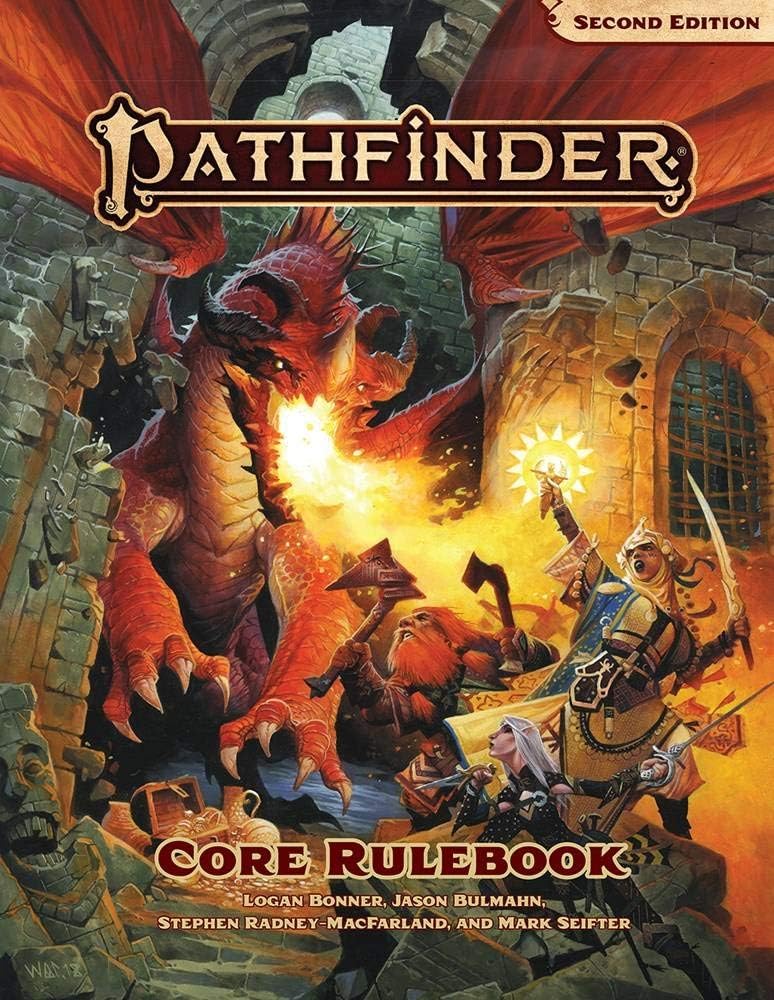
Pathfinder
System
Pathfinder 2e offers a familiar high-fantasy structure but upgrades the gameplay engine with a focus on tactical depth and fluid action. Its crowning achievement is the Three-Action Economy, which unshackles you from 5e’s often restrictive “Action/Bonus Action/Move” hierarchy. On your turn, you simply have three actions to spend however you like: you can attack three times, or attack once and then raise a shield and Demoralize an enemy, or cast a spell and Step away. This system turns combat into a dynamic team sport rather than a stationary damage race; purely optimizing your own damage output is rarely as effective as setting up a teammate for a critical hit. In PF2e, status effects, positioning, and maneuvers like Tripping or Grappling are mechanically potent, making martial characters feel versatile and powerful alongside spellcasters from level 1 to level 20.
Regarding character building, PF2e solves the “cookie-cutter build” problem by offering meaningful choices at every single level, not just when you pick a subclass. The system uses a modular feat structure—Ancestry feats, Class feats, General feats, and Skill feats—allowing you to build two characters of the same class and ancestry that play completely differently. Furthermore, the game’s “tight math” ensures that the game remains balanced and functional all the way to level 20. It is a system designed for players who crave agency, where your build decisions and tactical choices have a tangible, mechanical impact on the narrative.
Why Pathfinder 2?
The “Three-Action” Economy - PF2e replaces D&D5e’s complex web of actions and bonus actions with three simple points per turn, giving players the freedom to combine movement, attacks, and skills in any order they choose.
Deep Character Customization - Instead of front-loading all major choices at level 3, PF2e uses a modular “feat” system that allows you to mix and match ancestries, backgrounds, and class abilities to create a unique character that evolves at every single level.
Dynamic Monster Design - Monsters in PF2e are not just “sacks of hit points” with simple attacks; they feature distinct special abilities, reactions, and tactical weaknesses that force players to constantly adapt their strategies rather than using the same rotation every fight.
Free and Open Access - All rules (including every monster, class, and spell) are legally available for free on the Archives of Nethys, and the system is supported by high-quality, affordable digital tools like Foundry VTT, making it much cheaper to play than D&D.
Intent
The plan would be to take people through the introductory adventure Menace Under Otari, from the beginner box, to introduce everyone (GM included) to the new mechanics, then decide what to do next (if anything). Menace Under Otari comes with four pregenerated characters and is estimated to take 3 x 3hr sessions.
If we go further then the bias would be towards shorter standalone scenarios rather than a campaign.